
enVista Aspire™
Intermediate Optimized Monofocal IOLs
enVista Aspire™ combines monofocal distance performance with an Intermediate Optimized optic designed for a broader depth of focus.*1

Elevate the Everyday
Transcend the boundaries of standard monofocals and deliver your patients an IOL designed for the modern world — a fusion of uncompromised distance contrast sensitivity with an optic designed for a broader depth of focus.*1
Intermediate Optimized Optic →
Built for the Modern World →
Treat More Patients with More Precision →
*Based on optical bench testing – MTF study in ISO2 model cornea, comparison of MX60E and enVista Aspire™.More Range From a Monofocal Optic
Intermediate Optimized optics are designed to broaden depth of focus while maintaining the distance performance of the enVista® platform.*1,2
Intermediate Optimized Optic Design for a Broader Depth of Focus*
enVista Aspire™ uses higher-order aspheric coefficients on the posterior surface of the lens to create a broader depth of focus than conventional standard spherical monofocal and low-order aspheric IOL designs.*1†

The enVista Aspire™ IOL features a 1.5 mm central zone designed to create an intermediate optimized focal point alongside the distance focal point, contributing to a broader depth of focus.*1†
A Measurable Increase in Continuous Depth of Focus

In optical bench testing, enVista Aspire™ demonstrated a 120% increase in continuous depth of focus compared with enVista®.2*
†*Based on optic design characteristics. Data on File.
*Based on optical bench testing - MTF study in ISO2 (+0.28μm) model cornea.
Monofocal for the Modern World
An Intermediate Optimized monofocal option designed for patients who may not be candidates for presbyopia-correcting IOLs.1
A Thoughtfully Engineered Monofocal Optic
enVista Aspire™ combines an Intermediate Optimized central area with Controlled Curvature Change technology to create a broader depth of focus and a gradual optical transition from center to periphery.1,2
For appropriate cataract patients who may not be candidates for presbyopia-correcting IOLs, this design provides an Intermediate Optimized monofocal option within the enVista® platform.1
Three Design Elements. One Intermediate Optimized Optic.
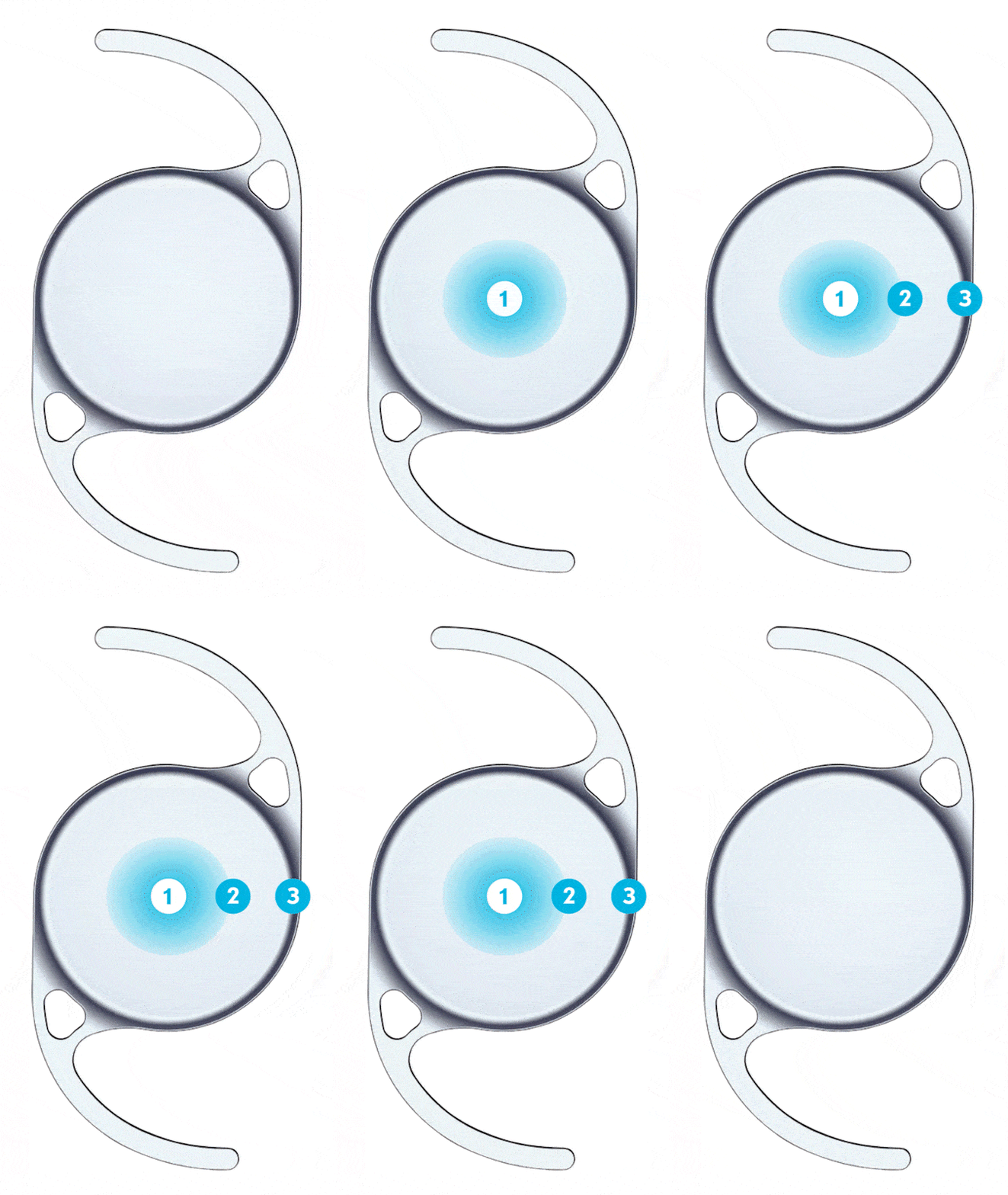
Together, these optic characteristics are designed to broaden depth of focus while minimizing dysphotopsias.1,2*
The enVista Aspire™ optic combines three design elements: an Intermediate Optimized central area using higher-order aspheric coefficients, 3C Controlled Curvature Change technology, and a gradual transitional distribution of light energy from center to periphery.1,2
Central Area
1) enVista Aspire™ features an Intermediate Optimized (IO) central area that uses higher-order aspheric coefficients on the posterior surface to create a broader depth of focus.1*
2) Featuring 3C (Controlled Curvature Change) technology, enVista Aspire™ optics are designed to harmonize the geometric power profile outward between the central base power and power at the periphery.2
Optic Power Profile
3) enVista Aspire™ uses a unique optic to create a gradual transitional distribution of light energy from the center to the periphery, an optic feature designed to minimize dysphotopsias.2
Discover the enVista® family of IOLs in 3D →
*Based on optic design characteristics. Data on File.
INTERESTED IN LEARNING MORE ABOUT ENVISTA ASPIRE™?
Schedule an Evaluation Today → Find your B+L Representative →
enVista Aspire™ Toric
Treat lower levels of astigmatism

Treat Astigmatism with More Precision1
Expand toric treatment options for cataract patients with lower levels of corneal astigmatism.1
Lower astigmatism is common in patients seeking cataract surgery.3
Even 0.50 D of astigmatism can affect functional and low-contrast visual acuity, making lower levels of corneal astigmatism relevant to cataract surgical planning.4
More Options Across the Astigmatism Treatment Range
enVista Aspire™ Toric broadens the treatable astigmatism range and adds low-cylinder and half-step options for appropriate cataract patients.1
Broaden the treatable astigmatism range in cataract surgery to
as low as <1.0 D at the corneal plane.1
The first and only Low-Cyl toric platform below 1.5 D
at the IOL plane commercially available in the US.
Only toric platform that treats half-step cylinders
(up to 3.5 D at IOL plane).
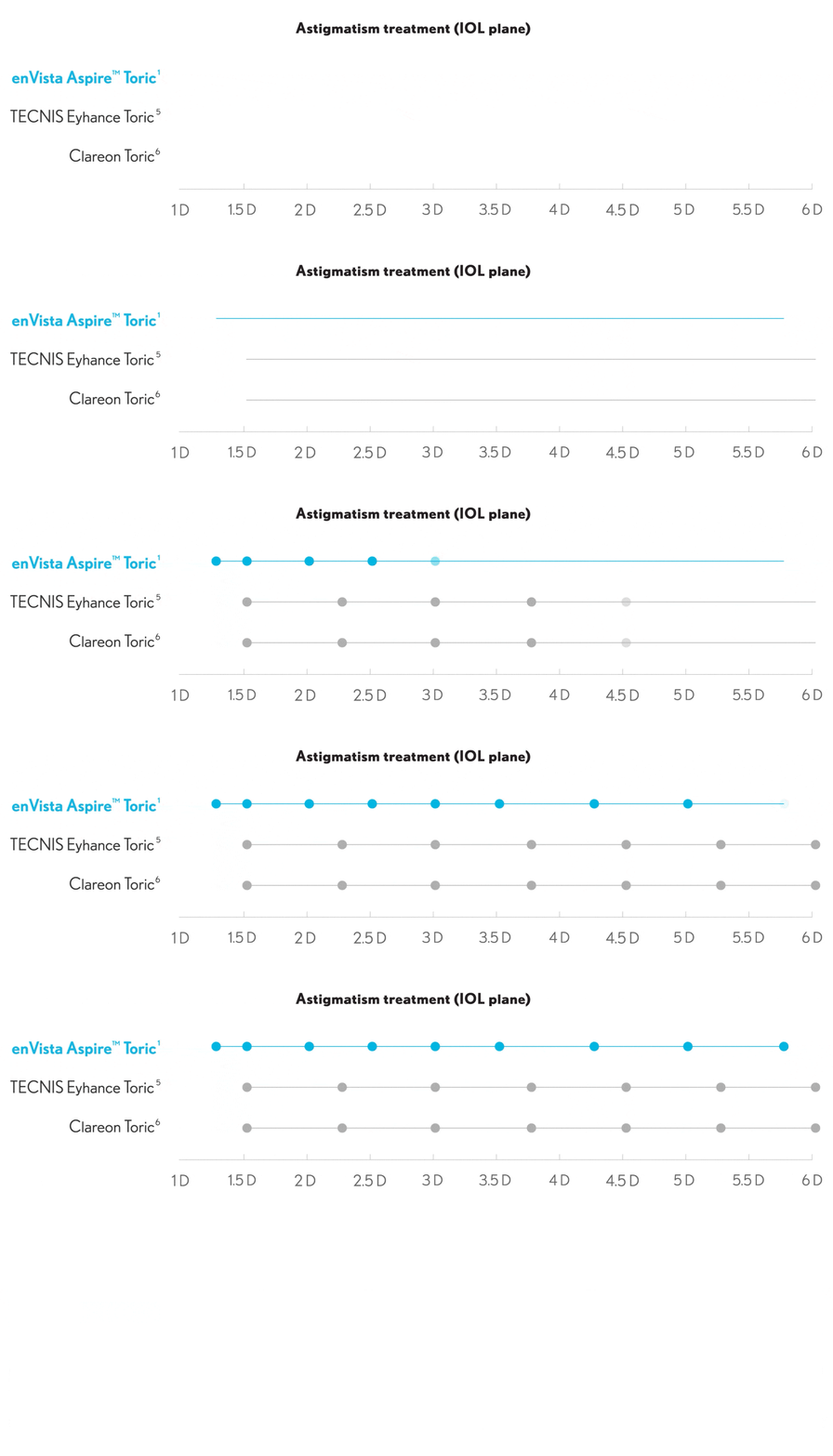
The enVista Aspire™ Toric treatment range includes 1.25 D through 5.75 D cylinder powers at the IOL plane, with low-cylinder and half-step options for astigmatism correction during cataract surgery.1*
*Comparison to available multifocal toric platforms approved in the US
Correcting cataracts and astigmatism. BOTH at the same time.
The enVista® toric platform is designed to support stable positioning for astigmatism correction during cataract surgery.1
Designed for Rotational Stability
Toric alignment and rotational stability are important considerations for visual outcomes. The enVista® toric platform is designed to support reliable positioning through the postoperative period.1
Clinical study data provide a view of rotational stability through 180 days after surgery.4*
The enVista® toric platform delivers proven rotational stability through 180 days post-surgery4*
Toric alignment and rotational stability are vital for patient satisfaction and visual outcomes. The enVista® platform is tailored to deliver exceptionally reliable rotational stability for precise astigmatism correction.

In the enVista® Toric MX60ET U.S. Clinical Study, 94.4% of eyes demonstrated ≤ 5° of rotation through 180 days post-surgery (n=108).4*
*enVista® Toric MX60ET US Clinical Study
Platform Design That Supports Positioning
Capsular bag contact is one element of the enVista® toric platform design intended to support stable lens positioning.
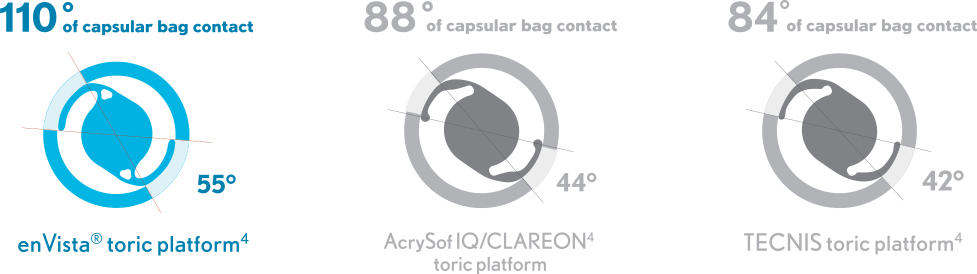
The enVista® toric platform provides 110° of capsular bag contact, compared with 88° for the AcrySof IQ/CLAREON toric platform and 84° for the TECNIS toric platform.4*
The enVista® Toric Calculator:
Your Partner in Accuracy
Powered by the advanced Emmetropia Verifying Optical (EVO) formula, the enVista® Toric Calculator sets the new standard for predicting spherical equivalence and providing data for low astigmatism cases.1
References:
- enVista Aspire™ Directions for Use.
- Data on file. enVista Aspire™.
- Cataract & Refractive Surgery Today. Now’s the Time to Adopt Elective IOLs. Published 2010. Accessed October 17, 2023. Available at: https://crstoday.com/wp-content/themes/crst/assets/downloads/0210_supp.pdf.
- Miller AD, Kris MJ, Griffiths AC. Effect of small focal errors on vision. Optom Vis Sci. 1997;74(7):521-526.
- TECNIS Toric Directions for Use, Johnson & Johnson.
- Clareon Toric Directions for Use, Alcon.
- Lake JC, Victor G, Clare G, et al. Toric intraocular lens versus limbal relaxing incisions for corneal astigmatism after phacoemulsification. Cochrane Database Syst Rev. 2019;12(12):CD012801. doi: 10.1002/14651858. CD012801.pub2.
- Pantanelli SM, Kansara N, Smits G. Predictability of residual postoperative astigmatism after implantation of a toric intraocular lens using two different calculators. Clin Ophthalmol. 2020;14:3627–3634. doi: 10.2147/OPTH.S276285.
| enVista Aspire™ | |
|---|---|
| Model Number | EA (non-preload) |
| Material | Hydrophobic Acrylic |
| Optic Design | One-piece Aspheric, biconvex Posterior high-order aspheric surface |
| Optic Size | 6mm |
| Length | 12.5mm |
| Optic Edge Design | Sharp 360° square posterior edge |
| Haptics | Modified C, fenestrated |
| Refractive Index | 1.53 at 35° C |
| UV Cutoff | 389nm at 10% transmittance |
| Biometry | Optical |
Optical biometry |
Optical A-constant*: 119.1 ACD: 5.61 mm Surgeon Factor: 1.85 mm |
Applanation biometry |
Applanation A-constant*: 118.7 ACD: 5.37 mm Surgeon Factor: 1.62 mm |
| Other Features | Glistening free |
| Diopter Range | +6D to +34D (0.5D increments) |
*A-constant values are suggested as a guideline. Physicians should calculate lens power based on optimization of their experience and preference with IOL technology.
| enVista Aspire™ Toric | |
|---|---|
| Model Number | ETA (non-preload) |
| Material | Hydrophobic Acrylic |
| Optic Design | One-piece Aspheric, biconvex Posterior high-order aspheric surface Posterior toricity |
| Optic Size | 6mm |
| Length | 12.5mm |
| Optic Edge Design | Sharp 360° square posterior edge |
| Haptics | Modified C, fenestrated |
| Refractive Index | 1.53 at 35° C |
| UV Cutoff | 389nm at 10% transmittance |
| Biometry | Optical |
Optical biometry |
Optical A-constant*: 119.1 ACD: 5.61 mm Surgeon Factor: 1.85 mm |
Applanation biometry |
Applanation A-constant*: 118.7 ACD: 5.37 mm Surgeon Factor: 1.62 mm |
| Other Features | Glistening free |
| Diopter Range | +6D to +34D (0.5D increments) |
*A-constant values are suggested as a guideline. Physicians should calculate lens power based on optimization of their experience and preference with IOL technology.
| Cylinder Power | |||||||||
|---|---|---|---|---|---|---|---|---|---|
| IOL Plane | 1.25 | 1.50 | 2.00 | 2.50 | 3.00 | 3.50 | 4.25 | 5.00 | 5.75 |
Frequently Asked Questions about enVista Aspire™
1. What is the enVista Aspire™ IOL?
The enVista Aspire™ is an enhanced monofocal intraocular lens (IOL) for cataract surgery, designed to provide distance vision while broadening the depth of focus into the intermediate range.1,2 The enVista Aspire™ is supported by two complementary post-market clinical studies.2,3
2. How does enVista Aspire™ differ from a standard monofocal IOL?
Unlike conventional spherical monofocal and low-order aspheric IOLs, the enVista Aspire™ IOL uses Intermediate Optimized (IO) optics to create a small continuous increase in IOL power within the central 1.5 mm diameter.1
3. What lens powers are available for the enVista Aspire™ IOL?
The enVista Aspire™ IOL is available in powers from +6.0 D to +34.0 D in 0.5 D increments. The enVista Aspire™ Toric IOL is available in the same diopter range.1
4. How does the enVista Aspire™ IOL perform for distance vision?
In a post-market clinical study, mean binocular best-corrected distance visual acuity (BDVA) with the enVista Aspire™ IOL was better than 20/20 (−0.048 logMAR). Monocularly, all eyes achieved a BDVA of 20/32 or better, and 93.9% achieved 20/25 or better.2
5. How does the enVista Aspire™ IOL perform for intermediate vision?
In a post-market clinical study, the average binocular distance-corrected intermediate visual acuity (DCIVA) at 66 cm with the enVista Aspire™ IOL was 20/32.2
6. What range of vision does the enVista Aspire™ IOL provide?
In a post-market clinical study, patients with the enVista Aspire™ IOL maintained visual acuity of 20/32 or better from plano through −1.25 D of defocus, demonstrating a functional range of vision into intermediate distances.2
7. How does the enVista Aspire™ IOL support everyday activities?
The defocus performance observed with the enVista Aspire™ IOL translates to functional intermediate vision relevant to activities of daily living, including computer use, dashboard viewing, and food preparation.2 In a post-market clinical study, 65.8% of patients reported little to no difficulty using a computer or calculator.2
8. How satisfied are patients with their vision after receiving the enVista Aspire™ IOL?
Post-market clinical study results showed that at least 90% of patients with the enVista Aspire™ IOL reported satisfaction with their overall vision.2
9. What visual disturbances have patients reported with the enVista Aspire™ IOL?
Among patients evaluated in a post-market clinical study, 93.9% reported little or no bother from glare, while 92.6% reported little or no bother from halos and 92.6% reported little or no bother from starbursts.2
10. How does the enVista Aspire™ IOL perform for contrast sensitivity?
In a post-market clinical study, contrast sensitivity with the enVista Aspire™ IOL was evaluated under mesopic conditions with and without glare. Without glare, contrast sensitivity ranged from 0.923 ±0.410 log units at 12 cpd to 1.846 ±0.281 log units at 3 cpd. With glare, results at the same spatial frequencies ranged from 0.782 ±0.430 to 1.580 ±0.364 log units.2
11. How predictable are refractive outcomes with the enVista Aspire™ IOL?
Post-market clinical study results showed that 96.3% of eyes with the enVista Aspire™ IOL were within ±1.00 D of the intended refraction, and 75.6% were within ±0.50 D.2
12. Is the enVista Aspire™ IOL available for patients with astigmatism?
Yes. The enVista Aspire™ Toric IOL combines the intermediate optimized optical design of enVista Aspire™ with correction of corneal astigmatism. It is indicated for primary implantation in the capsular bag in adult patients for visual correction of aphakia and corneal astigmatism following cataract removal for improved uncorrected distance vision.4
13. What astigmatism range can the enVista Aspire™ Toric IOL treat?
With Low-Cyl technology, the enVista Aspire™ Toric IOL broadens the treatable astigmatism range to as low as <1.0 D at the corneal plane.1
14. How rotationally stable is the enVista Aspire™ Toric IOL?
Rotation of a toric IOL away from the intended axis can reduce its astigmatic correction.4 The enVista® Toric platform demonstrated rotational stability through 180 days post-surgery, with 94.4% of eyes showing ≤5° of rotation (n=108).5
15. How does the enVista Aspire™ Toric IOL perform for distance and intermediate vision?
In a real-world clinical study, all patients in the enVista Aspire™ Toric group achieved binocular best-corrected distance visual acuity (BDVA) of 20/25 or better. All patients also achieved binocular uncorrected intermediate visual acuity (UIVA) of 20/32 or better.3
16. How predictable are refractive outcomes with the enVista Aspire™ Toric IOL?
In a post-market, real-world study, eyes implanted with the enVista Aspire™ Toric IOL achieved a mean postoperative spherical equivalent of 0.00 ±0.32 D and a mean residual cylinder of −0.34 ±0.33 D.3
17. What clinical evidence supports the enVista Aspire™ IOL family?
Two post-market clinical studies evaluated the enVista Aspire™ IOL family across prospective and real-world clinical settings. One study included 82 patients (164 eyes) following bilateral implantation with the enVista Aspire™ IOL.2 A second study evaluated 150 eyes (84 patients) implanted with enVista Aspire™, enVista Aspire™ Toric, or a control monovision IOL.3
18. What delivery options are available for enVista Aspire™ IOLs?
Surgeons may choose the reusable BLIS® system7 or the single-use, preloaded EyeGility™ system.7 BLIS® supports 2.2 mm to 2.4 mm incisions,7 while EyeGility™ supports a 2.4 mm incision.7
19. What types of patients may benefit from the enVista Aspire™ IOL?
The enVista Aspire™ may be considered for cataract patients when the surgical goal is strong distance vision with some functional intermediate vision and a low burden of visual disturbances.2,3 Patient selection should include careful preoperative evaluation and clinical judgment to assess the potential benefits and risks of IOL implantation.6
20. What have surgeons reported about their experience with the enVista Aspire™ IOL?
In a real-world study, surgeons reported high satisfaction with enVista Aspire™ and enVista Aspire™ Toric. On a scale of 0 to 10, 83% of surgeons rated their overall satisfaction with enVista Aspire™ at 9 or higher, while 100% rated their overall satisfaction with enVista Aspire™ Toric at 9 or higher. Similar ratings were reported for individual lens qualities and outcomes, including centration, visual outcomes, and rates of visual disturbances.3
21. What safety outcomes have been reported with the enVista Aspire™ IOL?
In two post-market studies evaluating enVista Aspire™ and enVista Aspire™ Toric IOLs, no serious adverse events were reported.2,3
References:
1. enVista Aspire™ Directions for Use.
2. enVista Aspire IOL Clinical Study Report. Bausch + Lomb.
3. Donnenfeld E, Patel R, Singh IP, Tyson F, Stephenson D. A Multicenter Retrospective Study of Clinical Outcomes With an Enhanced Monofocal Intraocular Lens in Patients Undergoing Cataract Surgery.
4. enVista Aspire™ Toric Directions for Use.
5. Bausch + Lomb Surgical. Data on file.
6. enVista Aspire™ Surgeon Brochure.
7. Bausch + Lomb. Bausch + Lomb Launches EyeGility™ Inserter Preloaded IOL Delivery System in the United States. July 16, 2026.
-
Media
Title
Tag
-

BLIS® Inserter Loading Guide
Marketing Brochures enVista AspireMarketing Brochures enVista Aspire -

enVista Aspire™ Patient Brochure
Marketing Brochures enVista AspireMarketing Brochures enVista Aspire -

INJ100 Inserter Loading Guide
Marketing Brochures enVista AspireMarketing Brochures enVista Aspire -

IOL+OVD Product Catalog
Catalogs enVista Envy enVista enVista AspireCatalogs enVista Envy enVista enVista Aspire -
enVista® Aspire Features and Specifications
Marketing Brochures enVista AspireMarketing Brochures enVista Aspire -

enVista® Aspire Surgeon Brochure
Marketing Brochures enVista AspireMarketing Brochures enVista Aspire -
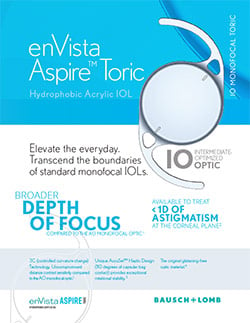
enVista® Aspire Toric Features and Specifications
Marketing Brochures enVista AspireMarketing Brochures enVista Aspire -

enVista® Aspire Toric Patient Brochure
Marketing Brochures enVista AspireMarketing Brochures enVista Aspire
-
Media
Title
Tag
-
enVista® Platform Technologies
Product Features enVista enVista Aspire enVista EnvyProduct Features enVista enVista Aspire enVista Envy -
enVista Aspire™ IOL | Eric Donnenfeld, MD, on Visual Acuity, Defocus Curve and Intermediate Vision
Patient Videos enVista AspirePatient Videos enVista Aspire -
enVista Aspire™ IOL | Kayla Unsell, MD, on Real-World Distance and Intermediate Vision Outcomes
Patient Videos enVista AspirePatient Videos enVista Aspire


